The rise of Agentic AI marks a significant shift in how organizations perceive operational automation, intelligence, and autonomy in decision-making. Businesses are rushing to build autonomous AI systems capable of reasoning, planning, and executing workflows with minimal human intervention.
These AI Agents are the next wave of AI for operations management, where processes self-optimize and decisions evolve dynamically. Yet, turning this vision into a production reality is quite tricky because challenges such as integrating multimodal data, maintaining contextual memory, ensuring scalability, and enforcing governance often slow down the process.
This is where the AWS cloud, along with its AI/ML services and infrastructure offerings, brings clarity and structure. The platform provides a unified environment for designing, deploying, and managing Agentic AI workflows, enabling enterprises to move from experimentation to production without requiring additional infrastructure.
In this blog, we will take a closer look at the key challenges organizations face and how AWS’s AI/ML services and frameworks, like Amazon Bedrock and AgentCore, simplify the process. We will also share some best practices for building Agentic AI systems on AWS.
Why Organizations Chase Agentic AI?
Agentic AI enables organizations to go from task-level automation to intelligent, independent, and outcome-driven decision-making.
- Operational Autonomy: Agents execute multi-step processes without manual intervention, improving speed and consistency.
- Adaptive Intelligence: They learn from outcomes and streaming data to optimize future decisions.
- Increased Efficiency: Agentic AI reduces human workload and accelerates execution across repetitive, high-volume tasks. This can translate into up to a 60% improvement in productivity.
- Faster resolution and recovery: They detect anomalies and initiate corrective actions in real-time to minimize downtime. According to McKinsey Research, they can reduce resolution times by 60-90%.
- Data-Driven Optimization: Agentic AI systems integrate real-time analytics to enable continuous performance improvement and leverage predictive insights for spontaneous execution.
Why Enterprises Struggle with Agentic AI Development?
This very level of autonomous decision-making and intelligence makes Agentic AI complex to build and scale. You need capabilities that can interpret context, reason across multi-source data, and act reliably under dynamic (sometimes unknown) conditions.
Agentic AI also demands advanced model orchestration, custom guardrails, governance frameworks, and scalable infrastructure.
Other challenges you must address when building Agentic AI:
- Configuring Agents for Contextual Understanding: Ensuring AI agents interpret dynamic inputs, intent, and data relationships accurately across changing scenarios.
- Ensuring Production Readiness: Transitioning from experimental prototypes or proof-of-concepts (PoCs) to fully functional, production-ready systems is a challenging task.
How AWS Powers Agentic AI Development and Autonomous IT Operations?
Enterprises require a foundation that supports large-scale intelligence and autonomous execution to unlock the full potential of Agentic AI. AWS offers a vast ecosystem of orchestration, analytics, compute, and AI/ML services, providing every layer required to design, deploy, and optimize AI Agents.
Below is a breakdown of key AI/ML services and related offerings that simplify the development and integration of Agentic AI on AWS:
Amazon CloudWatch
Purpose: Monitors metrics, logs, and events managed by Agentic AI on AWS environments in real-time.
CloudWatch serves as the “perception layer” for Agentic AI. It enables AI Agents to detect anomalies, performance bottlenecks, or threshold breaches across distributed systems. By turning raw telemetry into actionable insights, CloudWatch enables AI Agents to automatically trigger corrective actions and maintain situational awareness across the operational environment.
Amazon SageMaker
Purpose: Builds, trains, and deploys ML models for predictive insights and anomaly detection.
SageMaker is the predictive backbone of Agentic AI systems on AWS. It typically identifies early signs of potential failures and deviations. Within an Agentic AI framework, SageMaker’s outputs act as “pre-failure signals,” prompting AI Agents on AWS to proactively initiate preventive actions, such as adjusting workloads, scaling EC2 instances, or redistributing resources.
Amazon Bedrock
Purpose: Hosts foundational and fine-tuned models for reasoning, context interpretation, and decision orchestration.
Bedrock adds the cognitive layer to Agentic AI on AWS, helping agents understand context and weigh operational trade-offs. Once an anomaly is detected, Bedrock’s integrated models assess dependencies, business priorities, and compliance needs before deciding the best course of action.
AWS Lambda
Purpose: Executes event-driven tasks automatically without manual provisioning.
Lambda functions as the “action engine” of Agentic AI systems on AWS. After the agent’s reasoning phase, Lambda instantly converts decisions into executable actions, such as restarting microservices, triggering failovers, or updating configurations, to achieve minimal latency between decision and execution.
AWS Step Functions
Purpose: Manages multi-step, interdependent Agentic AI workflows across multiple AWS services.
In complex remediation or optimization processes, Step Functions sequences multiple operations (such as validation, backup, and restoration) into structured workflows. It also handles retries and rollbacks automatically, ensuring smooth orchestration even in AWS environments with multiple AI Agents.
AWS Systems Manager (SSM)
Purpose: Centralized Agentic AI automation and compliance control.
SSM ensures every AI Agent-triggered action aligns with governance rules. When an AI Agent issues a configuration update or patch command on AWS, SSM verifies permissions, executes the task securely, and records the action for auditability. This enhances transparency and compliance.
Amazon S3 and DynamoDB
Purpose: Store telemetry, performance outcomes, and learning data for Agentic AI.
These databases create the “memory layer” of an Agentic AI system on AWS (as well as other clouds). Post-incident data, such as before-and-after metrics and decision outcomes, is also stored for retraining models in SageMaker or refining reasoning patterns in Bedrock. This continuous feedback loop improves accuracy, reduces false positives, and enhances self-optimization over time.
Together, the above AWS services help build a resilient Agentic AI architecture that simplifies enterprise operations.
Best Practices for Building Agentic AI Systems on AWS
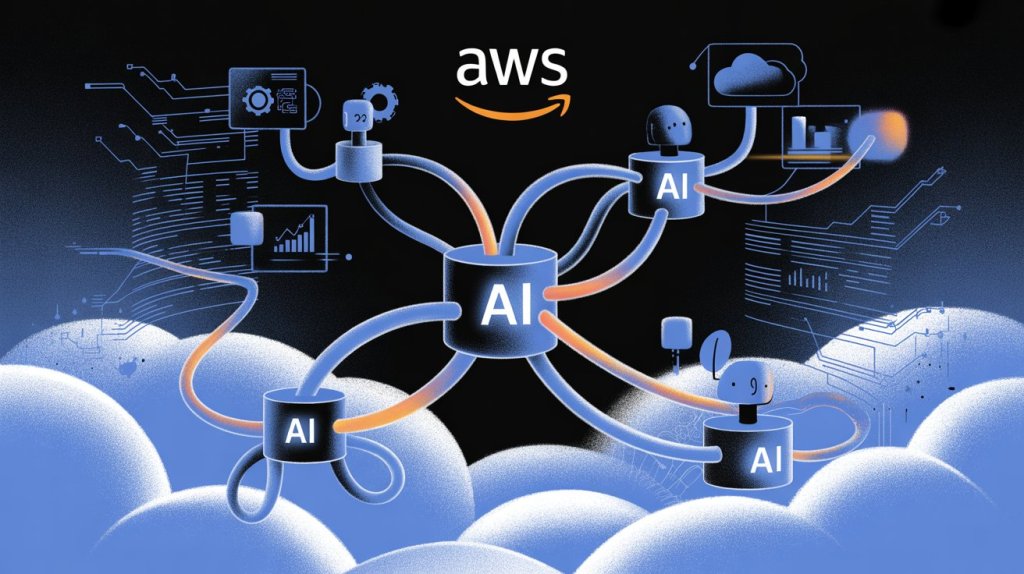
Developing an Agentic AI system on AWS is more than just integrating a few separately built AI Agents. It is rather about creating a network of AI Agents that can access all data sources, interact and learn from each other, and collectively optimize network performance for reliability, uptime, and consistent operations.
For success, keep the following Agentic AI best practices and principles in mind:
- Evaluate your Infrastructure and Validate Use Case: Work closely with AWS consultants to determine whether you need Agentic AI systems at all.
- Start Small, Scale Smart: Begin with a specific (non-critical) Agentic AI workflow or use case before expanding to broader enterprise functions.
- Build Modular Layers: Separate perception, reasoning, and action using AWS services like CloudWatch, Bedrock, and Lambda for easier updates and debugging.
- Set and Use Guardrails Wisely: Combine IAM (Identity and Access Management) policies, Systems Manager, and Config to control access and enforce governance across Agentic AI systems on AWS.
- Design for Feedback: Store AI Agent decisions in S3 or DynamoDB and retrain models in SageMaker for continuous improvement.
- Ensure Observability: Use CloudWatch dashboards and X-Ray tracing to monitor Agentic AI’s performance in real-time and detect drift early.
- Plan for Fail-Safe Recovery: Integrate rollback paths in Step Functions to ensure quick correction in the event of anomalies.
- Keep Humans in the Loop: Retain oversight for high-impact decisions, ensuring accountability and compliance.
- Invest in Agentic AI Development Services: To build fool-proof, custom Agentic AI systems on AWS, opt for professional development and benefit from expertise and established processes.
Ending Note
Agentic AI is moving from concept to capability, and platforms like AWS are powering this transition. With its growing suite of AI and ML services, AWS is making it easier for organizations to design intelligent AI Agents.
In the near future, you can expect Agentic AI on AWS to evolve beyond complex automation to full-scale cognitive ecosystems. These ecosystems will feature multiple AI Agents collaborating across domains, connecting to enterprise data, and continuously refining their reasoning through contextual memory and feedback loops. Additionally, as AWS continues to build its generative, multimodal, and agentic capabilities, the boundary between automation and decision-making will continue to blur.
Frequently Asked Questions
How to build autonomous AI Agents on AWS?
To build autonomous AI systems on AWS, developers can utilize AWS’s AI/ML services, including Amazon Bedrock, SageMaker, Lambda, and Step Functions. These managed services work together to help AI Agents perceive data, reason intelligently, and act automatically.
What are common use cases of Agentic AI in operations management?
Typical applications of Agentic AI in operations management include automated incident resolution, predictive maintenance, workflow orchestration, demand forecasting, and intelligent resource scaling.
What are the benefits of Agentic AI for business operations?
Agentic AI for business operations improves efficiency, accuracy, and agility. It helps organizations respond faster to changing conditions, reduces manual intervention, and enables proactive problem-solving. These capabilities ultimately lead to cost savings and better service uptime.
What challenges are there in deploying Agentic AI on AWS?
Deploying Agentic AI on AWS can be complex due to challenges like data integration, real-time orchestration, and model coordination. Businesses also need to address governance, reliability, and scalability to ensure that their autonomous AI systems perform consistently across dynamic environments.
How to monitor and govern Agentic AI systems on AWS?
Organizations can use Amazon CloudWatch to monitor system metrics and events in real-time, while AWS Systems Manager, IAM, and AWS Config enforce policies, access controls, and compliance.
What is the cost of running Agentic AI on AWS?
The cost of running Agentic AI on AWS depends on model usage, compute capacity, and the volume of data processing. AWS offers flexible, pay-as-you-go pricing and cost-optimization tools such as Compute Optimizer and Savings Plans to help you predict budgets based on usage.
 App Development Blogs
Leave a comment