The digital world is rapidly evolving into a post-monolithic system, transitioning to cloud systems and cloud-based applications that promise unparalleled scalability, flexibility, and speed. With the adoption of cloud-native solutions and microservices design, the complexity of systems management, deployment, and scaling grows considerably.
It is at this point that DevOps approaches come in. DevOps enables the management of distributed systems by combining cultural philosophies, automation, and modern tools. The importance of DevOps in cloud-native development cannot be overstated; it is the cornerstone that enables faster delivery and continuous improvement. According to Credence Research, the DevOps market will generate $35.1 billion in 2030 from $9.85 billion in 2022.
In this blog, we will discuss why DevOps is essential to cloud-native applications and microservices, reasons why businesses struggle with it, and the optimal DevOps practices in microservices architecture to guarantee long-term success.
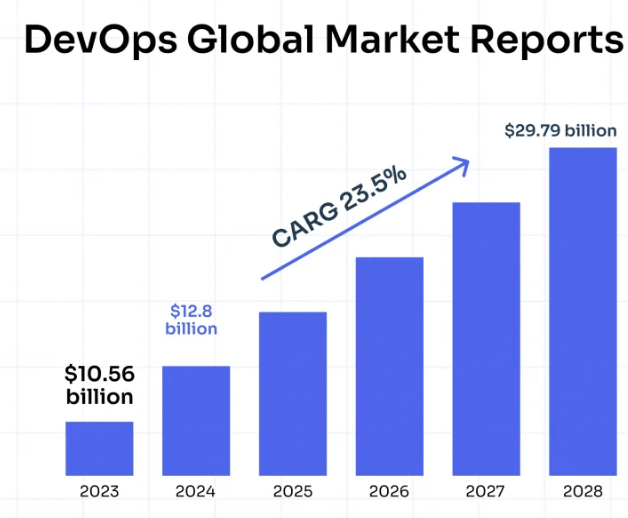
Source: Bigohtech
The Intersection of Cloud-Native, Microservices, and DevOps
The business groups are not posing the question of what is cloud-native, or what are microservices?-they are concerned with how do we make them work well at scale. The thing is that all these methods increase the complexity of software delivery unless it is backed by the appropriate operational model.
- Cloud-native requires elasticity and constant evolution. Deployments are no longer an infrequent event, but a daily event that occurs in a variety of settings.
- Microservices architecture manages multiple moving parts. Individually, each service may be lightweight and modular, but as a system, they form an ecosystem, which is challenging to coordinate until there is automation and cooperation.
- The glue comes in the form of DevOps approaches. DevOps is not a single definition, but rather the bond between these new paradigms to work together in the way they provide agility, stability, and speed under a single umbrella.
Without this merger, organizations tend to experience sluggish rollouts, fragmented observability, and fragile systems. Using it, they open the door to a model in which the CI/CD pipelines, infrastructure automation, and proactive monitoring are not extras, but rather the foundation of providing reliable cloud-based applications.
Microservices DevOps Challenges Without Proper Practices
Although microservices and cloud-native are agile, they usually involve bottlenecks and inefficiencies without appropriate DevOps strategies. The most widespread difficulties are as follows:
Deployment Complexity
Microservices increase the number of deployments. DevOps automation is not implemented with cloud-native applications, resulting in limited coordination among teams. No update status among services, resulting in broken builds or unreliable releases.
Scalability Issues
Hand scaling of hundreds of services is prone to errors. DevOps scalability failure in cloud native systems can lead to outages, performance bottlenecks, and increased costs of the cloud.
Monitoring Blind Spots
Distributed systems come with huge logs and metrics. In the absence of centralized observability tools, teams are no longer able to see service dependencies, and troubleshooting is slow and reactive.
Siloed Teams
The traditional development and operations silos are unable to keep up with the pace of microservices. In cloud-native companies, the absence of a DevOps culture also leads to the breakdown of collaboration, slows down releases, and makes the organization less agile.
Security Risks
Vulnerabilities are exposed by a microservice, API, or container. DevSecOps practices incorporated into the pipeline help organizations avoid failures to comply and possible breaches.
How DevOps Strengthens Cloud-Native and Microservices Architectures
1. CI/CD Microservices and Cloud native
DevOps automation of cloud-native apps is based on Continuous Integration and Continuous Delivery (CI/CD). Regular updates can be implemented with automated pipelines and reduced downtime, with a major improvement in the deployment speed.
2. Infrastructure as Code (IaC)
IaC tools such as Terraform and Ansible enable businesses to use DevOps with cloud-native applications to automate the provisioning and scaling of cloud infrastructure. This provides uniformity between development, testing, and production environments.
3. Containerization & Orchestration
DevOps is collaborating with Docker and Kubernetes in managing microservices. This is one of the DevOps strategies of scalable microservices deployment, as it uses automated scaling, self-healing deployments, and effective orchestration.
4. Monitoring, Logging, and Observability
The centralized monitoring tools, such as Prometheus, Grafana, or ELK, are used by teams to overcome microservices DevOps challenges. These provide real-time intelligence, proactive troubleshooting, and minimized downtimes.
5. DevSecOps for Security
Security is an important parameter to be integrated at every stage. By embedding DevSecOps practices, businesses ensure compliance, automated vulnerability scans, and secure container deployments.
Business Benefits of DevOps in Microservices and Cloud-Native
DevOps for cloud-native apps and microservices is not only a technical solution, but it also has direct business outcomes. The following are the benefits of organizations:
1. Faster Time-to-Market
Microservice and cloud-native applications have automated CI/CD pipelines that enable businesses to release features and updates several times per day, faster than their competitors and in response to customer demands.
2. Higher Reliability
Stability is guaranteed by automated rollbacks, container orchestration, and real-time monitoring. This reduces downtime and provides a more predictable mission-critical cloud application environment.
3. Cost Optimization
Scalable microservice deployment strategies based on DevOps can enable the scaling of resources (up or down) according to demand so that the costs of cloud infrastructure can be kept to a minimum.
4. Scalability
With code automation through DevOps, it is now possible to manage traffic spikes that could occur either seasonally or due to a sudden increase in visitor numbers without affecting performance.
5. Improved Customer Service
More updates, less downtime, and accelerated innovation cycles imply that the end-users have smooth, reliable, and continuously improving cloud-based applications.
Future Outlook: DevOps in Modern Application Development
The future of DevOps for cloud native applications is changing at a rapid pace. Modern software is being developed, deployed, and managed via emerging technologies and practices that are transforming the way organizations are built, deployed, and managed. 77% of organizations currently depend on DevOps to deploy software, or plan to do so soon (source: HBR). Here are some key directions:
1. GitOps for Cloud-Native Deployments
GitOps utilises Git as the source of truth for deployments. This helps facilitate version-control, auditable, and automated flows, ideal when handling large-scale microservices.
2. AI-Powered DevOps (AIOps)
DevOps pipelines are also being enhanced with artificial intelligence to anticipate failure, analyze response automation, and optimize performance. This minimizes the amount of manual intervention and accelerates the process of troubleshooting.
3. Quick Deployment with Cloud-Native and DevOps
Organizations of the future will depend on closer coupling between DevOps services and cloud-native infrastructures, ensuring agility, scalability, and shorter innovation cycles.
4. DevSecOps Ongoing Development
Security will become a much more powerful part of the DevOps techniques, and compliance checks, vulnerability scans, and automated remediation will be precisely integrated into pipelines.
5. Serverless Computing
As a larger number of organizations are moving to serverless models, DevOps groups are forced to change their strategies and manage functions, event architecture, and ephemeral infrastructure effectively.
Cloud-Native DevOps Best Practices
To achieve the full advantages of DevOps in microservices and cloud applications, organizations must embrace best practices that balance speed, security, and scalability:
1. Use Microservice CI/CD Pipelines
Automate building, testing, and deployments to enforce the frequent and reliable release of multiple microservices without downtime.
2. Apply Infrastructure as Code (IaC) Tools
Providing, maintaining, and scaling cloud infrastructure becomes simple with tools such as Terraform, Ansible, or Pulumi to provide a consistent experience across environments.
3. Embrace Kubernetes Container Orchestration
Kubernetes streamlines implementation, scaling, and resilience of microservices, thus forming the foundation of contemporary DevOps strategies.
4. Uniform Monitoring and Observability
Centralized logging, metrics, and tracing with tools such as Prometheus or the ELK stack provide the teams with complete insight into system health and dependencies.
5. Adhere to DevSecOps Principles
The system needs to be integrated with security checks and compliance checks, as well as vulnerability scanning, directly into the DevOps pipeline to create safer cloud-based applications.
6. Establish a DevOps Culture of Shared Responsibility
Bust silos in terms of development, operations, and QA by promoting ownership, collaboration, and lifelong learning among teams.
Concluding Thoughts
DevOps in modern application development is no longer an option but a necessity. DevOps provides scalability, speed, and security regardless of whether you are running cloud apps, developing cloud-based applications, or implementing cloud-native solutions.
DevOps practices for microservices to CI/CD for cloud-native systems all provide measurable business value. Organizations may use DevOps consulting services or hire a DevOps consulting company to future-proof their cloud-native journeys.
The message is obvious: Why DevOps is so important for cloud-native applications and microservices lies in its ability to turn complexity into agility so that businesses remain competitive in the cloud-first age.
 App Development Blogs
Leave a comment