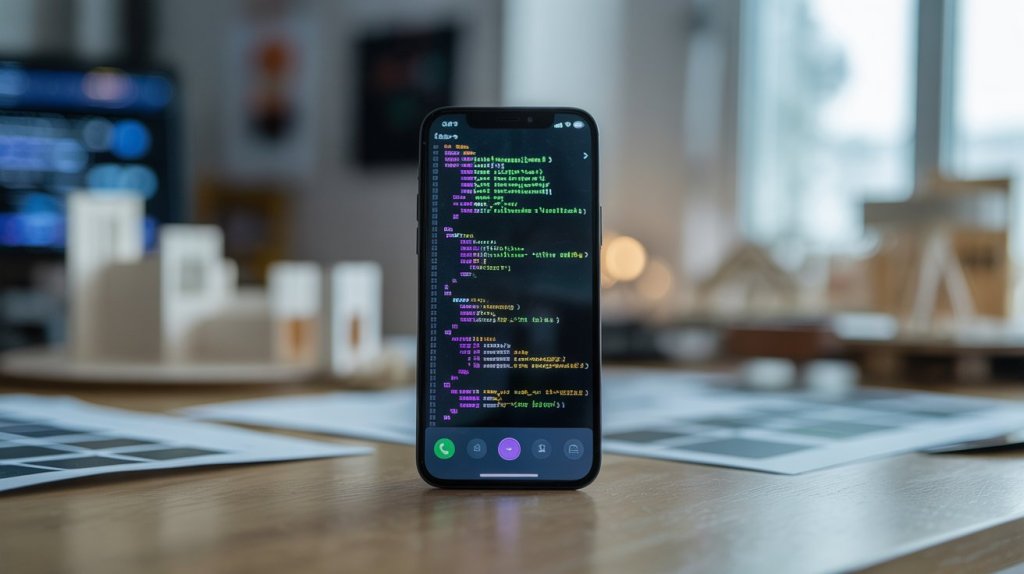
The AI revolution is transforming the way mobile apps are defined, developed, and utilized. As the application is becoming smarter and more intuitive, the demand for real-time intelligence is increasing exponentially. Statista reports that global AI adoption soared to 72% in 2024 from 55% in 2023. Hence, it is no secret that AI is quickly becoming a mainstream app development technology instead of remaining an emerging trend.
Native development is the most effective method of unleashing on-device AI potential in this new age. Whether it’s Swift iOS development or Kotlin Android development, direct-to-device development offers better performance, a higher privacy level, and a more seamless user experience.
Through models such as Core ML on iOS and Android Neural Networks API (NNAPI) on Android, developers can create powerful AI models that operate locally without necessarily communicating with the cloud. Here, this blog goes deep into the process of developing native iOS and Android applications in the direction of AI, the importance of on-device intelligence, and how to prepare your apps.
Why On-Device AI Matters Today
Earlier, mobile applications used cloud-based AI, where the data is transmitted to remote servers and analyzed, and the findings are returned to the device. Despite its strength, this method presents several constraints:
- Slow reaction of real-time applications such as image recognition or language translation is caused by the latency problems.
- Increasing concerns about privacy as sensitive user information is conveyed on the internet.
- Offline functionality is limited by reliance on steady connections in the network.
This is where the concepts of AI integration into mobile apps in a native context will come in handy. Direct running on the device has many benefits:
- Short latency is useful in real-time prediction, as is the case with a camera-based object detection or a typewriter with a predictive typing capability.
- The information is kept secure because the confidential calculations are done in the field.
- Offline functionality increases the reliability of the app, particularly in areas with low connectivity.
Some of the most popular real-life applications are health tracking programs that process sensor data, apps that provide predictive typing recommendations, and image editing ones that do on-the-fly optimization.
The Role of Native Development in On-Device AI
In creating AI-driven mobile applications, it is better to use native development instead of cross-platform options to have the best performance and access all platform-specific APIs. The reason why Swift for iOS and Kotlin Multiplatform Mobile for Android are game-changers is this:
- Direct communication with hardware accelerators (e.g., Apple Neural Engine or Android chipsets) enables quick model inference.
- Fluent access to full maturity models, such as Core ML and NNAPI, increases development productivity and model performance.
- The responsiveness and stability of the app are guaranteed by the use of effective memory management and optimization methods.
Although cross-platform solutions can be ineffective in exploring the low-level hardware functionality, native Android app development and native iOS app development can use them to maximum advantage.
Core ML: Empowering On-Device Intelligence for iOS Apps
Apple has a machine learning platform named Core ML, which is optimized to incorporate pre-trained models into iOS applications. In a standard Swift iOS development process, here is how it works:
- Develop a separate AI model training with software such as PyTorch or TensorFlow.
- Translates the model into Apple’s proprietary .mlmodel format, e.g., Core ML Tools.
- Add the .mlmodel file to your Swift application.
- Make predictions with the API based MLModel at runtime.
Example Use Cases:
- Real-time object recognition in camera applications.
- Predictive keyboard suggestions based on user behavior.
- Personalized assistant with voice recognition.
The following conditions are for performance optimization:
- Model quantization to use less memory and infer faster.
- Predict in batches where possible to enhance throughput.
This close integration of Core ML in native iOS application development offers a powerful method to apply real-time intelligence whilst offering a smooth user experience.
Android Neural Networks API (NNAPI): Driving AI on Android Devices
On the Android platform, Android Neural Networks API (NNAPI) with Kotlin Android development provides hardware inference of machine learning models. The most common is that developers use TensorFlow Lite, which can be programmed to use NNAPI delegates to run models faster.
Typical Workflow:
- Train and develop a model externally.
- Translate the model into .tflite format for inference.
- Add TensorFlow Lite to your Kotlin code.
- Allow NNAPI delegate to use hardware acceleration (where supported).
Example Use Cases:
- Face recognition to log in safely.
- Language translation applications in real-time.
- Health data analysis applications to provide instant feedback.
Difficulties in developing On-Device AI
No doubt multiple advantages are possible, but there can still be issues faced during AI integration in mobile apps, e.g.:
- Model size vs Performance: The bigger models are more precise but need more memory and slow performance.
- Battery Life and Thermal Bands: Intensive computations can easily consume battery and overheat.
- Android Fragmentation: Diverse hardware among devices makes the consistent support of NNAPI difficult.
- It may be a challenge to debug on-device inference problems without special profiling equipment.
- Swift and Kotlin developers must fill the gap between mobile development and AI model expertise, and this increases the learning curve.
To cope with these complexities and have strong implementation performance, hire mobile app developers from a recognized agency for professional practices.
The Future of Native AI-Powered Apps
The future of apps is determined by the emerging trends in the development of mobile AI:
- TinyML models provide microcontroller inference with ultra-efficiency.
- The next-generation accelerators are rendering the on-device AI even faster and less energy-intensive.
- Privacy-preserving AI methods, such as federated learning, are being incorporated.
Adopting Swift iOS development and Kotlin Android development, developers will be at the top of this revolution to make apps fast, secure, and functional. According to The Low-Code Perspective, 34% of IT leaders report that their organizations use AI-assisted coding extensively. Professional mobile app development services should be hired by companies to establish themselves as leader of these technologies.
Conclusion
Use of AI in mobile apps as a native development is not a luxury anymore, but necessitates state-of-the-art user experiences. The use of frameworks like Core ML and NNAPI provides the security of powerful, real-time, and secure AI capabilities working on the device entirely.
For businesses aiming to stay competitive with their robust services, it’s time to consult mobile app development services proficient in Swift for AI development and Kotlin multiplatform mobile development. Doing so ensures your applications are ready for the future: fast, intelligent, and privacy-centric.
 App Development Blogs
Leave a comment